16 November 2026 · 4 min read
Which bonsai tools do you need, and what does each one do?
Choose a starter kit, match each cutter to the right job and keep your blades sharp and clean from tree to tree.
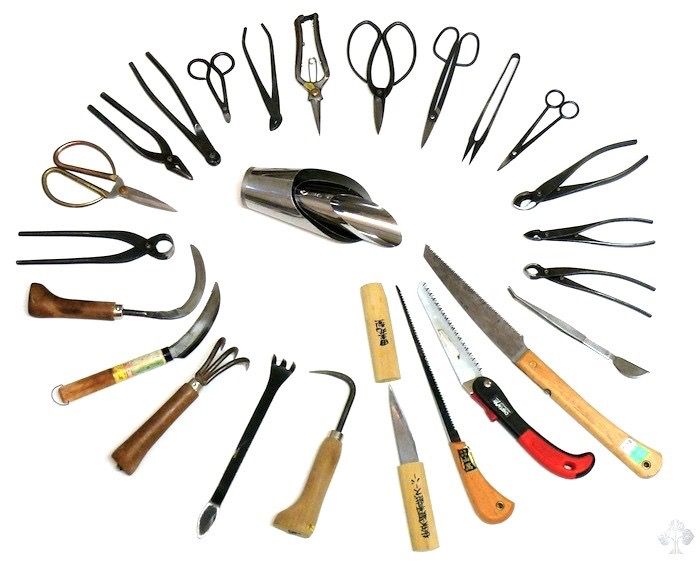
The concave cutter is the single most important of the bonsai tools, because its hollowed cut lets a branch wound heal flush with the trunk. A beginner can start with that cutter, sharp pruning scissors and wire cutters. Knob cutters, root cutters, saws, jin pliers and tweezers come later, each for a specific job.
- A quality concave cutter, sharp pruning scissors and wire cutters are the starting essentials.
- Concave and knob cutters leave hollow wounds that heal without a swollen scar.
- Roots should be cut with a dedicated pair, because soil grit dulls branch cutters.
- Blades should be wiped dry, oiled, sharpened and disinfected between trees.
What is the rule of 3 in bonsai trees?
The rule of 3 names the three starting essentials: a quality concave cutter, sharp pruning scissors and wire cutters. Together they cover branch removal, routine trimming and wiring, the work a new tree demands first.
Bonsai shears, also called butterfly shears or trimming scissors, have long handles and short, sharp blades. The long handles reach into the canopy. That makes them the tool for maintenance pruning and for trimming leaves and twigs.
How concave and knob cutters help wounds heal
A concave cutter makes a curved, hollowed cut where a branch meets the trunk. Because the cut sits slightly below the trunk surface, the wound heals flush and leaves no swollen scar. A straight cut would leave a stub that the tree tends to thicken around.
Knob cutters have spherical, round-edged jaws. They remove knobs, lumps and bulges, and leave a deep, round, concave wound that heals cleanly. A common technique is to use the knob cutter after a branch has come off with the concave cutter, hollowing the wound further so the bark rolls over it without a bump.
Concave pruners, knob cutters and root cutters all cut in a bypass fashion. Their edges overlap slightly, so the jaws must close far enough to pass each other without leaving a gap. A gap means the tool crushes the last fibres instead of severing them.
What tools do you need to wire a bonsai?
Wiring needs wire in several diameters, a wire cutter and a plier for bending the wire. Bonsai wire is made from annealed aluminium or copper. Beginners should use aluminium, because it is easier to apply. Small versions of the cutter and plier suit a collection of shohin bonsai.
Bonsai wire cutters have rounded blade tips that cut wire flush without damaging the bark beneath. Standard hardware-store wire cutters nick branches. Keep the concave cutter away from wire as well, since cutting wire with it will dull the blade quickly.
Jin pliers strip bark and tear or crush wood fibres to create deadwood features, known as jin and shari. They also bend heavy wire. For larger deadwood work, a branch or trunk splitter is a sharp plier used to split dead branches and stumps.
Root work calls for separate bonsai tools
Root cutters are heavy, straight-edged tools for thick, woody roots. Branch cutters should stay out of the soil, because grit dulls their edges, so keep a dedicated pair for root work. General root pruning can be done with a strong standard shear, while hard roots call for a root plier or a saw.
When repotting, root hooks and rakes open the rootball and comb out the roots. Chopsticks or bamboo sticks then work fresh soil into the gaps around them.
Japanese pruning saws cut on the pull stroke. Pushing hard on one bends or breaks the blade, so let the pull do the work.
Tweezers handle the fine work. Angled tweezers suit weed pulling, repotting and general tasks, while straight tweezers are better for pulling needles and leaves. Good bonsai tweezers should be about eight inches long.
What to look for when buying tools
Japanese tools are known for high quality and high prices. Chinese tools are improving in quality for their price. Black steel tools need more maintenance because they can rust, and stainless steel tools cost more.
Size matters for the concave cutter. Concave branch cutters come in sizes from about 170mm for shohin to 285mm for large trees, and Masakuni, Kaneshin and Ryuga are named as leading Japanese brands.
Wazakura sells hand-forged, Japan-made bonsai tools. Its range includes concave branch cutters, knob cutters, root cutters and wire cutters, along with jin pliers, trunk splitters and kits built from them.
How to care for tools between trees
Wipe blades dry after each use and oil them with camellia oil or mineral or gun oil, which keeps moisture off the steel. Sharpen edges on a whetstone so they keep cutting cleanly instead of crushing tissue. Add tool care to your care plan or journal so it becomes part of the routine.
Disinfect tools between trees. A blade that has cut an infected branch can carry fungal, bacterial or viral infections into the next tree it touches.
Sources
This article was written from the reporting below.
- thesweetandsimplekitchen.com — 10 Best Bonsai Tool Sets 2026: Expert Reviews & Picks
- bonsaiempire.com — Bonsai tools and materials - Bonsai Empire
- bonsai-bci.com — Essential Bonsai Tools - BCI
- portlandbonsai.org — Six Essential Tools for Bonsai — Bonsai Society of Portland
- wazakurajapan.com — Premium Bonsai Cutters Made In Japan II Wazakura Japan
Generated with sources · reviewed by a human: yes · Approved by mariofilk, 28 Oct 2026 · Sourcing policy