12 October 2026 · 6 min read
Recognising and Treating Common Bonsai Pests and Diseases
Identify the insects and infections most likely to hit your bonsai, then choose a treatment that starts gentle and escalates only when needed.
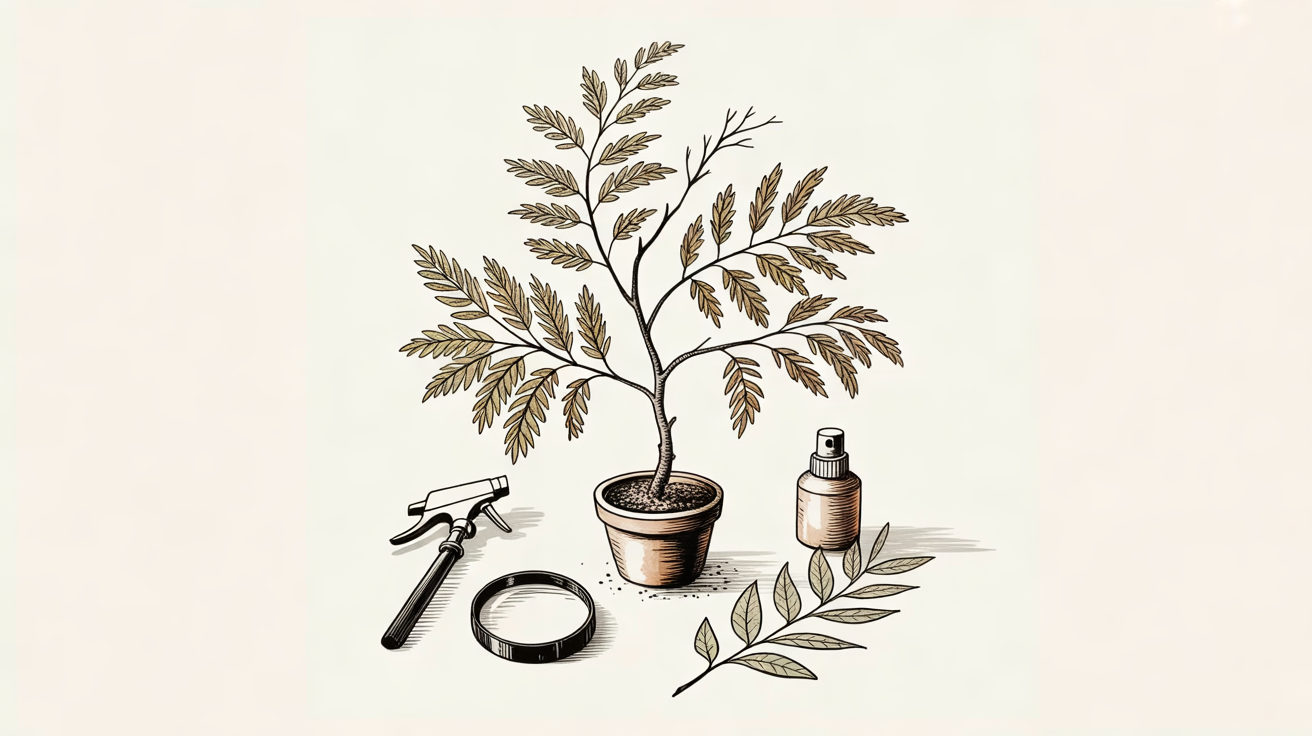
Most trouble on a bonsai comes from a short list of sap-sucking insects and fungal infections. A grower who looks closely every week can catch most of it early. Treatment should start with the gentlest method and escalate only if needed, and the best defence is a healthy tree: weakened trees are targeted first.
Prevention starts with care
Most bonsai problems are cultural before they are biological, and overwatering is the single most common way bonsai are killed. Trees given proper watering, light, soil and feeding are more resistant to pests and diseases. Well-draining soil matters, and fallen leaves and flowers should be cleared from the soil surface because they rot and give pests a good place to live.
Regular weekly monitoring, ideally with a 5X hand lens, is the key to integrated pest management. The aim is to keep pests and diseases at acceptable levels, not to eliminate them. A few habits help:
- Quarantine new trees for a few weeks before placing them near an existing collection.
- Isolate any infested tree from other trees to stop pests spreading.
- Do not fertilise a pest-stressed tree until the infestation is under control, because fertiliser pushes tender new growth that pests prefer.
Common pests and how to spot them
Spider mites are very common bonsai pests. They are tiny arachnids, not insects, that live mainly on the undersides of leaves, spin fine webbing and pierce leaf cells to drain them. Because they are almost invisible to the naked eye, they are often noticed first through stippled, dusty or bronzed foliage. They thrive in hot, dry conditions.
A spider mite life cycle lasts about 5 to 7 days, so follow-up spraying is necessary. Two-spotted mites are much harder to control than red spider mites. The other common pests are easier to tell apart by where they sit and what they leave behind.
| Pest | What it looks like | Where to look | Signs |
|---|---|---|---|
| Aphids | Small, soft-bodied sap-sucking insects | New growth, shoot tips, leaf undersides | Sugary honeydew that attracts ants and can lead to mould |
| Mealybugs | Soft, oval insects covered in white, waxy, cotton-like fluff | Leaf axils, branch joints, soil around the roots | Fluffy white clusters |
| Scale insects | Small bumps under a protective shell or waxy coating | Bark, stems, leaf veins | Easily overlooked because they do not move |
| Whiteflies | Tiny white sap-sucking insects | Leaf undersides | A cloud flies up when foliage is disturbed; yellowing and honeydew |
| Slugs and snails | Not given | Mostly outdoor trees, in damp weather | Nibbled leaves and slimy trails |
Ants on a tree are often a sign of aphids, because ants farm aphids for their honeydew.† Root mealybugs are common and hard to spot, so check the roots if a tree declines despite good care. Other common pests include vine weevils, caterpillars and other leaf-chewers, and fungus gnats.
Treating pests
Integrated pest management works in a fixed order: cultural controls first, then biological, then chemical controls of increasing toxicity. Spraying pesticides usually upsets the natural balance of predator organisms, which is one reason to hold chemicals back. A typical escalation looks like this:
- Spray with lukewarm soapy water or a firm jet of water to dislodge aphids, mites and whiteflies. This works well for early-stage problems.
- Remove pests by hand: touch mealybugs with a cotton swab dipped in 70% isopropyl alcohol, wipe or squash aphids off, and scrape scale off with a soft toothbrush or chopstick.
- Mix 1 tbsp mild dish soap and 1 tbsp neem oil in 1 litre of warm water for spider mites, whiteflies and aphids. Apply in the morning or evening, not in hot sun, every 5 to 7 days for 3 to 4 treatments.
- On dormant, leafless trees, use diluted lime sulfur against overwintering scale, mites and fungal problems. It is caustic and cannot be used on evergreens or after trees have leafed out.
Most pest treatments kill adults but not eggs, so plan on 3 to 4 rounds about a week apart. Neem oil smothers aphids and overwintering insects and also prevents fungal spores from germinating. A mix of neem oil and insecticidal soap can be applied about 3 times per growing season.
Some growers take a much heavier preventive line, spraying insecticide at least monthly. Their routine uses Bayer 3 in 1 sprayed on the canopy and soil surface plus Bonide Systemic granules on the soil, with both products used so insects do not become immune. This routine is far more chemical than the gentle-first order above.
Fungal and bacterial diseases
Powdery mildew is a fungal disease that leaves a white powdery film on leaves and shoots. It is common on broadleaf species such as Chinese elm and maples and should be treated quickly. Its spores usually reach new host trees on woolly aphids or other sucking insects. Good airflow, more sun, dry foliage at night, and neem oil or milk diluted 1:10 with water all help keep it in check.
| Symptom | Likely cause | Response |
|---|---|---|
| Black spots that can spread into patches over the whole leaf | Fungal infection | Isolate the tree, prune infected leaves, apply fungicide, possibly several times |
| Brown or orange spots on leaf undersides | Rust fungus, which can spread to branches; brown spots can also be summer sunburn | Treat as a fungal infection if it is rust |
| Rounded spots with brown to black halos, or angular spots with a yellow halo | Fungal or bacterial leaf spot | Keep leaves dry and remove diseased leaves; fungicides are preventive only |
| Black film on leaves | Sooty mold growing on honeydew from aphids, scale or whiteflies | Control the insects and wash the mold off; the mold itself does little harm |
| Yellowing, browning and needle drop on conifers | Needle cast, which infects in warm, wet weather | Remove diseased branches, improve airflow, sometimes use fungicides |
| Curled shoots that look burned on rose-family trees | Fire blight | Prune out dead branches; streptomycin can prevent it |
Needle cast can severely damage bonsai-sized trees. Fire blight is a destructive bacterial disease (Erwinia amylovora) of apple, pear, quince, hawthorn, cotoneaster and other rose-family trees, and pruning is the only cure. Trees with true blight or wilt generally cannot be saved. Remove them, bag them and throw them away rather than composting them, then sanitise your tools.
Fungicides are either protective, preventing infection, or curative and systemic, and no fungicide works against all fungal infections. Bordeaux mixture should not be used on crabapple, pear, plum, azalea, rhododendron or juniper. Copper fungicides can damage new foliage.
Root rot
Root rot is caused by soil-borne fungi and water-moulds in waterlogged, oxygen-poor soil, and it turns roots black and soft. Prevention means routine monitoring, regular repotting and never keeping the soil constantly wet. If rot has set in, the treatment runs in this order:
- Unpot the tree.
- Cut away rotten roots back to white tissue.
- Rinse the remaining roots.
- Soak them for 5 minutes in a full-strength triforine (Funginex) solution.
- Repot in fresh, quick-draining soil and water with Superthrive.
Keeping problems small
A weekly look with a hand lens, a clean soil surface and careful watering will catch most pests and diseases while they are still minor. When something does appear, isolate the tree and identify the problem from where it sits and the damage it leaves. Then begin with water, soap or hand removal, and reach for stronger products only if those fail.
Sources
This article was written from the reporting below. Claims marked † are not confirmed by two independent outlets.
- bonsai2u.co.uk — Common Bonsai Pests and Diseases: How to Spot and Treat Them
- bonsaioutlet.com — Bonsai Pests: Identification & Treatment Guide | Bonsai Outlet
- bonsaiwonderland.com — Bonsai Problems: Diagnose Yours by What You Can See
- evergreengardenworks.com — Integrated Pest Management for Bonsai
- bonsaiempire.com — Bonsai pests and diseases - Bonsai Empire
- bonsaibotanist.org — Chapter 54 Identifying and Treating Common Fungal and Bacterial Diseases | Growing & Styling Bonsai in Piedmont NC
- thebonsaisupply.com — Pests & Insects – Bonsai Supply
Generated with sources · reviewed by a human: yes · Approved by mariofilk, 12 Oct 2026 · Sourcing policy