26 October 2026 · 4 min read
How to Tell When a Bonsai Needs Water: Check the Soil, Not the Calendar
Learn the soil, weight and moss checks that show when a bonsai is thirsty, and how to adjust your routine for season and species.
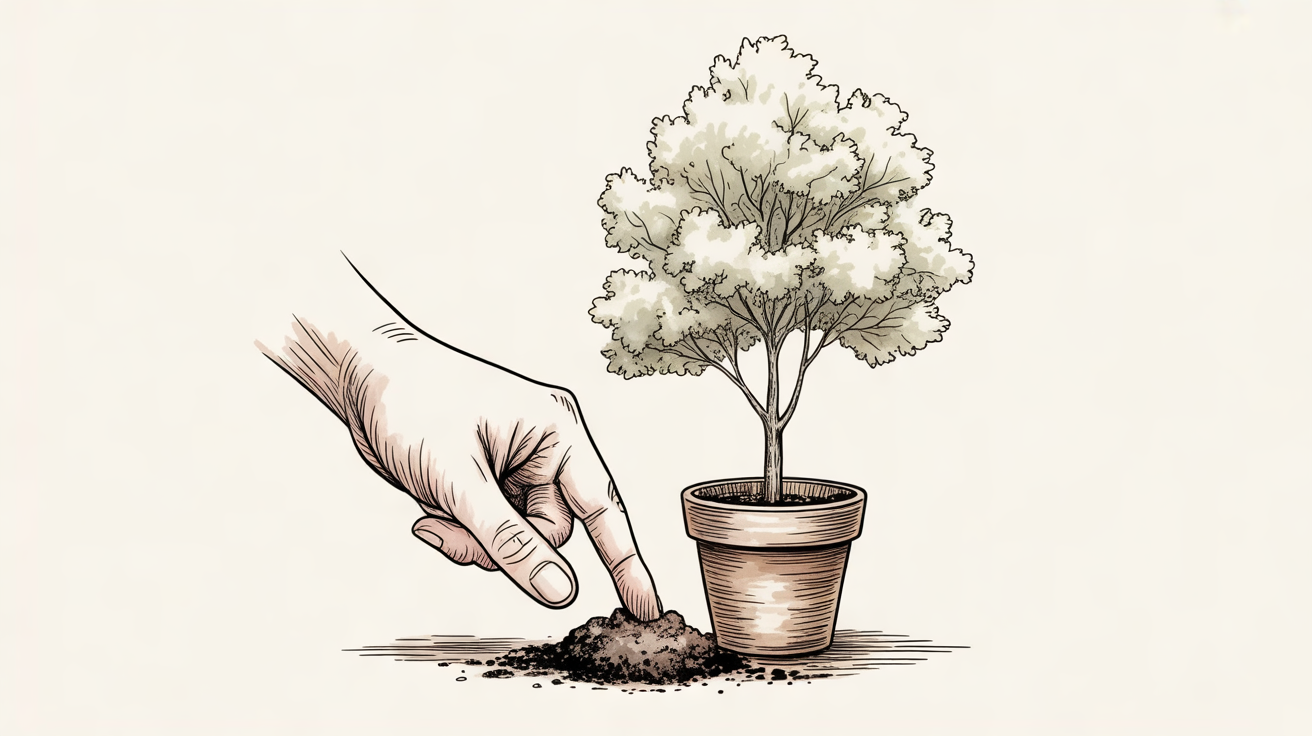
A bonsai should not be watered on a fixed schedule. Check the soil, or the tree, each time, and water only when it actually needs it. Overwatering and underwatering both come from watering by the calendar rather than by the soil, and a check before every watering prevents both.
Trees do not dry out at the same pace. Even trees standing side by side, or of similar size, dry at different rates depending on species, pot size, soil mix and sun exposure. Each one has to be assessed on its own.
Why a calendar does not work
Water demand changes with season and weather. Trees dry faster in summer, heat, wind and sun, and they need much less water during winter dormancy. In hot summer weather a small outdoor bonsai may need watering once or twice a day, while in dormancy its needs fall sharply.
Species also differ in what they prefer. Conifers and succulents such as jade like to dry out between waterings, whereas tropicals such as ficus prefer consistently moist soil. A single watering calendar cannot suit both kinds of tree.
Checking the soil directly
The finger test
Press a finger about half an inch, roughly 1 cm, into the soil. If it feels dry and warm, water; if it feels cool and moist, wait. For plants in general, a broader guideline is to water when the top 1–2 inches begin to feel dry and to hold off if that depth is still moist, checking outdoor pots daily.
The chopstick test
The surface can mislead. The top layer of bonsai soil may look or feel dry while the lower part of the pot is still wet, so judging by the surface alone can lead to overwatering. A wooden chopstick or skewer pushed into the soil samples the bottom of the pot.
Leave the chopstick in place for about 30 seconds before reading it. If it comes out pale and dry, the tree needs water. If it comes out dark and damp, wait. Plastic or metal rods do not work, because they do not absorb water.
Other probes
- Screwdriver: it goes in easily when the soil is moist and gets harder to push in as the soil dries.
- Digging to the roots: if the soil where the roots are growing is dry, the tree likely needs water; if it is wet, it can probably wait.
- Pressing at the base of the trunk: press firmly on the moss or soil there each day, and if it feels moist, cool, or soft and spongy, no water is needed.
Reading weight, colour and moss
Lifting the pot is a reliable check, because a dry root ball feels noticeably lighter than a freshly watered one. Lift a pot just after watering and again over the following hours. That teaches you its full weight and how the soil colour changes as it dries, which experienced growers use to judge when to water.
Colour depends on the soil mix. Akadama lightens from orange-brown to pale tan as it dries, whereas lava and pumice look the same wet or dry. Moss gives a similar signal: it looks dull and crisp when the pot is dry, and plump and green when it is moist.
Leaves are an unreliable guide. By the time a bonsai wilts it is already in trouble. Wilting can also be caused by overwatering, through dead roots, as well as by drought.
When and how much to water
The aim is to water when the topsoil has begun to dry but before the whole root ball is bone dry. Bonsai soil should not be allowed to dry out completely. Morning is generally the best time to water, though a tree that is dry in the afternoon should be watered then rather than left until the next day.
When you water, cover the whole soil surface until water runs freely from the drainage holes. Wait a short while, then water again so the whole root ball is saturated. Misting the leaves is not a substitute, because it does not deliver water to the roots.
Immersion gives its own reading. When a pot is submerged, vigorous bubbling from the root ball means the soil was very dry, and slow bubbling means the tree was less thirsty.
Recognising overwatering
Soil that stays wet for days is a warning sign. So are a sour or stagnant smell, and wilting or leaf drop despite wet soil. These point to too much water rather than too little.
A checking routine instead of a watering calendar
A sound care plan replaces fixed watering days with a fixed checking routine. Look at each tree on its own, pair a soil probe with the weight of the pot, and let the season and the species guide how often you check. Recording what you find in a journal helps you learn how each pot behaves through the year.
The tree itself tells you when it needs water, provided you look at the soil rather than the date. Water when the check says so, water thoroughly, and then wait until the next check says so again.
Sources
This article was written from the reporting below.
- bonsaioutlet.com — How to Water a Bonsai Tree | Bonsai Watering Guide | Bonsai Outlet
- webonsai.com — How to Water a Bonsai Tree Correctly — WeBonsai
- bonsaiwonderland.com — How to Water a Bonsai (Without Killing It)
- bonsaitonight.com — How to evaluate bonsai water needs - Bonsai Tonight
- alrightgreen.com — The Chopstick Test: The Simplest Way to Know When Your Bonsai Really Needs Water – alrightgreen_com
- bonsaiwest.com — Bonsai Care and Maintenance < Bonsai West
- bonsaisocietyqld.asn.au — Watering Secrets – Bonsai Society of Queensland
- bonsainut.com — How to tell when my substrate is in need of watering? | Bonsai Nut
Generated with sources · reviewed by a human: yes · Approved by mariofilk, 19 Oct 2026 · Sourcing policy