13 October 2026 · 5 min read
An Introduction to Bonsai Styles: Formal Upright to Cascade
Learn to recognise the main bonsai styles by trunk angle and shape, then choose a first style, species and pot that suit how you want to work.
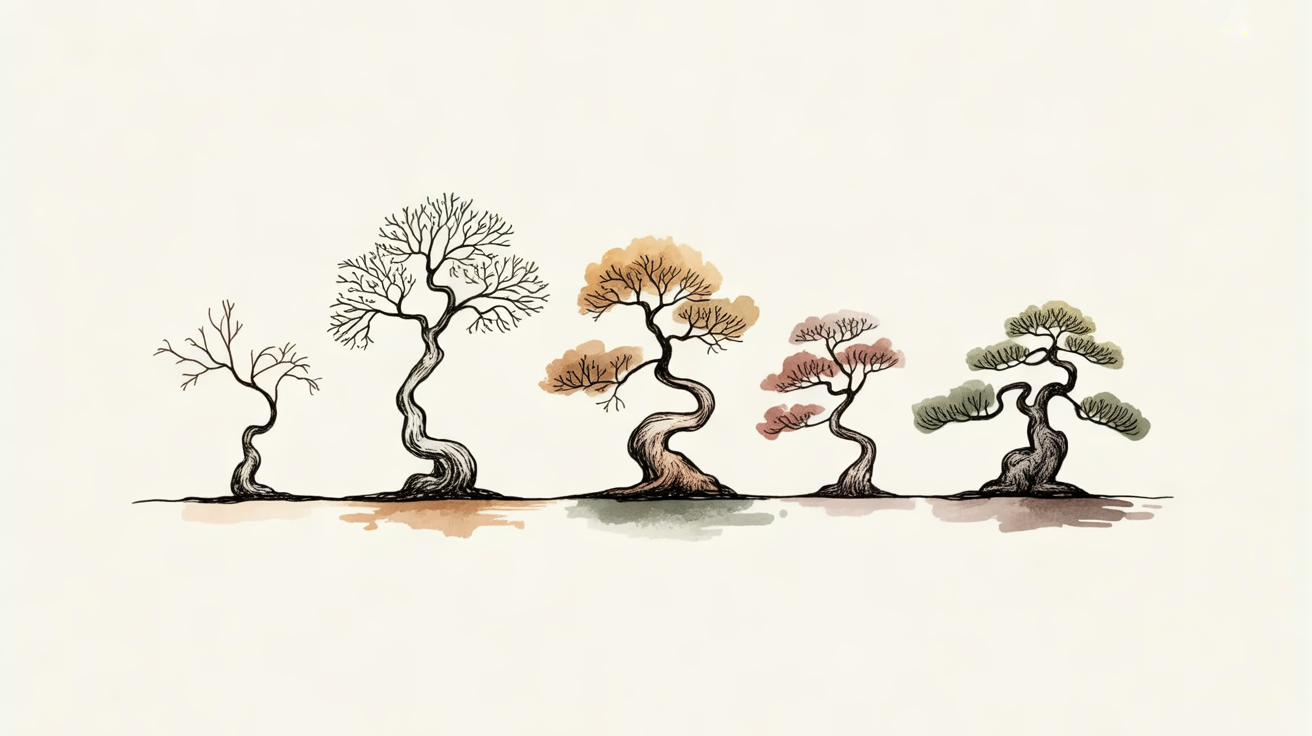
Bonsai is usually classified into five basic styles: formal upright, informal upright, slanting, cascade and semi-cascade. Each style is defined by the overall shape of the tree and by how far the trunk slants away from an imaginary vertical axis. If you are starting out, the formal upright is considered the easiest style for a beginner to develop.
Bonsai originated in China and was developed by the Japanese. In the 13th century they collected wild trees that had been dwarfed by nature and grew them in pots. That is why each style carries a Japanese name, and learning those names makes it easier to follow books and teachers.
How the styles are classified
Picture a vertical line rising from the base of the trunk. A tree's style depends on how closely its trunk follows that line and on the shape the whole tree makes. In some styles the apex sits directly over the base. In others the trunk leans away from the line or drops below the pot.
Two further styles, windswept and literati, are sometimes treated as basic styles as well. They appear in the section on other styles below. The table sets out the five core styles so you can compare them at a glance.
| Style | Japanese name | Defining feature |
|---|---|---|
| Formal upright | Chokkan | Straight, tapering trunk with the apex directly over the base |
| Informal upright | Moyogi | Trunk twists in a rough S shape, apex in line with the base |
| Slanting | Shakan | Tree grows at about 60–80 degrees to the ground |
| Cascade | Kengai | Trunk bends down to below the bottom of the pot |
| Semi-cascade | Han-kengai | Trunk does not grow below the bottom of the pot |
Formal upright (Chokkan)
The formal upright has a straight, upright trunk that tapers. It is thicker at the bottom and thinner towards the top. The apex of the tree stands directly over the base of the trunk, so the tree follows the vertical axis closely.
Guidance on where branching should start differs. One account says branching begins at about one quarter of the trunk's length. Another advises placing the first branch at roughly a third of the way up. Note in your journal which height you chose for each tree so you can judge the result in later seasons.
This style is best suited to conifers, and larches, junipers, pines and spruces are all suitable species. Formal upright trees look best in oval or rectangular containers. Place the tree about a third of the distance from one end of the pot rather than in the centre.
Informal upright (Moyogi)
In the informal upright style the trunk twists and turns, roughly in an S shape. Even so, the apex stays in line with the base of the tree. The movement happens along the trunk rather than in the tree's overall position.
The top of the tree also bends slightly towards the front. This contrasts with the erect leader of the formal upright. When you look at the two styles side by side, the gentle forward tilt is one of the clearest differences.
Slanting (Shakan)
A slanting tree grows at an angle of about 60–80 degrees relative to the ground. The lean is the main feature of the style and distinguishes it from the upright forms.
To stop the tree looking as if it might topple, the first or lowest branch grows in the opposite direction to the lean. That branch creates visual balance by pulling the eye back across the base. When you plan the branching on a slanting tree, choose this lowest branch first.
Cascade (Kengai) and semi-cascade (Han-kengai)
The cascade style imitates trees that grow down a cliff or an embankment in nature. The trunk grows upward briefly and then bends downward, reaching below the bottom of the pot. Because of that downward growth, cascade bonsai are planted in tall pots.
The recommended container is higher than it is wide, in a round or hexagonal shape. The height of the pot gives the trunk room to fall without the tree resting on the surface below.
The semi-cascade style differs in one key respect. Its trunk does not grow below the bottom of the pot, unlike the cascade. If you are unsure which of the two you are looking at, compare the lowest point of the trunk with the base of the container.
Other styles you will meet
Beyond the five basic styles, several others turn up often enough to recognise. These are the ones you are most likely to see named:
- Windswept (Fukinagashi): the branches and trunk appear swept to one side, as if by constant wind. It is sometimes treated as a basic style.
- Literati (Bunjingi): a crooked trunk that is largely without branching except at the top. It too is sometimes treated as a basic style.
- Broom (Hokidachi): suits deciduous trees with fine branching. A straight trunk branches out at about one third of the tree's height into a ball-shaped crown.
- Double trunk (Sokan): common in nature but not very common in bonsai. Both trunks usually grow from one root system.
- Forest (Yose-ue): several trees planted in a staggered pattern in a large, shallow pot.
- Multi-trunk (Kabudachi): a single tree with three or more trunks, which sets it apart from a forest planting of separate trees.
Choosing where to begin
Once you can judge a trunk against that imaginary vertical line, most styles become easy to identify. Check whether the apex sits over the base, whether the trunk leans, and whether it drops below the pot. Those observations alone will place a tree in one of the basic styles.
For a first tree, the formal upright is a sensible choice because it is considered the easiest to develop. A conifer such as a juniper or pine, set off-centre in an oval or rectangular pot, follows the guidance for the style. Keep a simple record of branch heights and changes through each season, and you will have a reference to build on when you try the more demanding styles.
Sources
This article was written from the reporting below.
- brusselsbonsai.com — Styles of Bonsai defines the five basic styles of bonsai
- pubs.ext.vt.edu — The Art of Bonsai | VCE Publications | Virginia Tech
- bonsaiempire.com — Bonsai styles, shapes and forms - Bonsai Empire
- bonsai-nbf.org — Know Your Styles: A Guide to Bonsai Configurations — National Bonsai Foundation
Generated with sources · reviewed by a human: yes · Approved by mariofilk, 13 Oct 2026 · Sourcing policy